Peptide Purity Overview 98%, 99% & Research-grade Clarified Prg
Comprehending Peptide Purity Screening
To conclude, recognizing peptide purity levels and qualities aids you make informed decisions for Cellular Research your experiments. A peptide's purity percent tells you just how much of that sample is the actual bargain versus by-products, with typical research study qualities being around 95% as much as 98-99% for added purity. Analytical HPLC and MS are your close friends below-- HPLC evaluates purity, and MS confirms identification, together guaranteeing you recognize what's in your tube.Explore our brochure to view validated research study compounds and learn more about our testing and quality assurance process. Even small pollutants can alter results, lower reproducibility, or present unwanted variables right into a research study. Researchers depend upon accurate, confirmed compounds to ensure their findings are both legitimate and consistent.
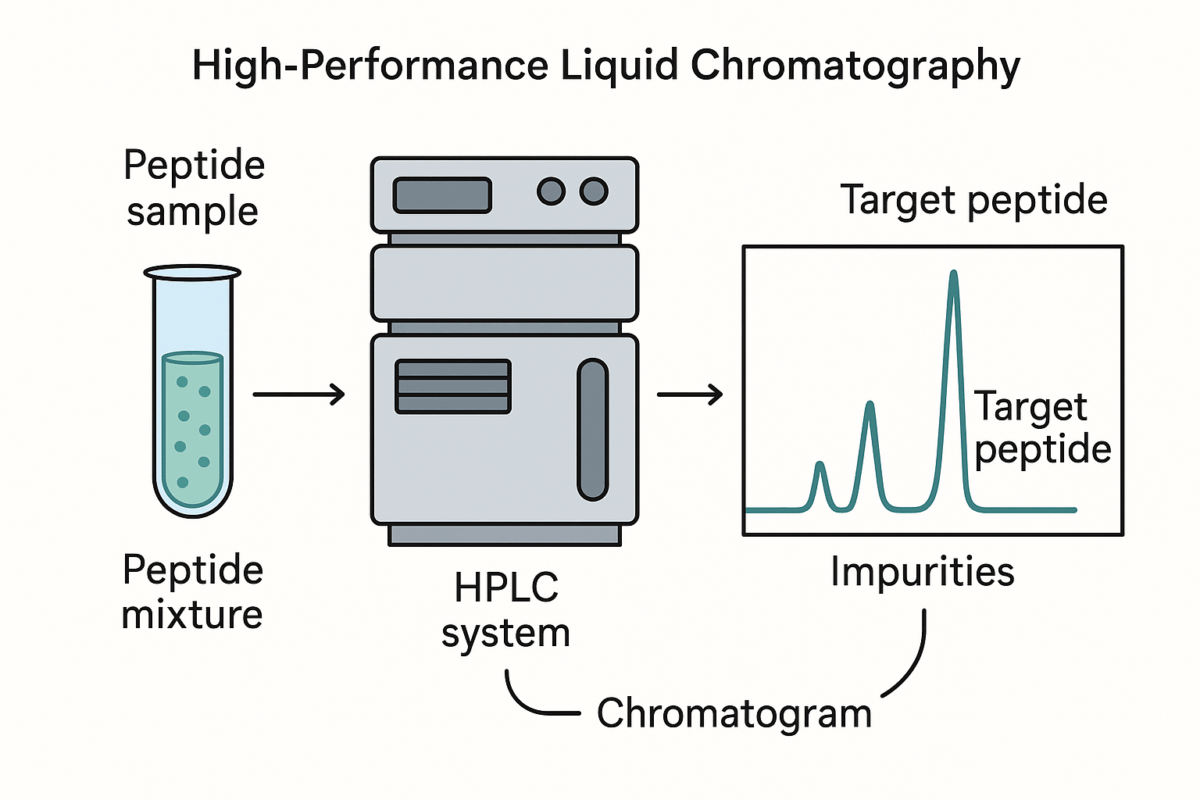
The liquified peptide example is infused right into a stream of fluid solvent (the mobile stage) that flows via a tube packed with small particles (the stationary stage). Different particles "stick" to those fragments with various toughness, so they travel through the column at different speeds. Subtle distinctions in basic material pureness and framework can bring about incongruities in the activity of the end product.Why Should Scientists Require Third-party Recognition?
These adjustments change the peptide's biological activity and chromatographic account. Peptides are sensitive to temperature level, light, and enzymatic environments, making them susceptible to destruction, which influences efficacy. BOC Sciences provides accelerated security, light security, and enzymatic destruction experiments to methodically examine formula stability dangers.- Discover our directory to watch validated study compounds and find out more regarding our testing and quality assurance procedure.
- In COA testimonial, it generally consists of HPLC pureness screening, mass spectrometry identity verification, and batch-specific documents showing the evaluated great deal, approach, results, and day.
- As an example, in order to ensure success in different peptide experiments, it may be needed to remove trifluoroacetic acid (TFA), or to examine the solubility of hydrophobic peptides before executing the required experiments.
- Significantly, this purity figure is normally established after filtration (e.g. by HPLC) and concentrates on peptide impurities-- it does not count residual water, salts, or counter-ions in the dried out peptide powder.
- A peptide provided at 75% purity and one at 99% pureness aren't just various qualities-- they can produce meaningfully various end results in the very same assay.
Most peptide suppliers and study labs depend on a number of well-established logical approaches. All items are sold for study, lab, or analytical objectives only, and are not for human usage. Product descriptions and classifications do not imply any therapeutic end results. At Chameleon Peptides, every item ships with thorough third-party testing documents. You can learn more about our analytical screening methods on our screening and high quality page. A 2016 study released in Nature found that greater than 70% of scientists had attempted and stopped working to replicate another scientist's experiments.
Research Study Uses Of Peptide Chemical & Physical Evaluations
Theoretically, peptide pureness is measured by the chromatogram generated by reversed stage HPLC, and in addition, we can acquire the number and loved one amount of possible by-products by computing the peak area. A top notch chromatogram has a single, balanced main optimal with a level baseline on either side. " Tailing"-- where the height routes off slowly on one side-- can show column issues, sample overloading, or additional communications in between the peptide and the fixed phase. In this configuration, the stationary stage is hydrophobic (water-repelling), commonly C18-bonded silica. The mobile phase is a slope of water and a natural solvent like acetonitrile, commonly with a small amount of trifluoroacetic acid (TFA) to develop the tops.
These can be especially problematic due to the fact that their chromatographic behavior is really similar to the target peptide, making them more Click here for more difficult to divide throughout filtration. When a peptide is 98% pure, that remaining 2% isn't random sound-- it's specific, identifiable types of byproducts. Mass spectrometry gauges the molecular weight of a substance with extreme precision. For peptides, the most typical strategies are electrospray ionization (ESI-MS) and matrix-assisted laser desorption/ionization time-of-flight (MALDI-TOF). HPLC divides a blend right into its individual components based on just how each molecule engages with a specifically created column.